

CEST
14:58
TODAY’S WEATHER
Find information quickly and easily
Gibraltar North Front Cemetery
North Front Cemetery daily public opening times: 8.00 until 19:00.
Contact Details:
- Cemetery Manager 20078491
- Cemetery Keeper 20077279
- Email address nfc@gibtelecom.net
Address:
Halifax Road, North Front Cemetery, Gibraltar GX11 1AA
Management:
The North Front Cemetery staff is currently comprised of a Cemetery Manager, two Cemetery Keepers, eight gravediggers and contracted maintenance staff. The Cemeteries Act 2018 is the relevant legislation that regulates the management of cemeteries in Gibraltar. It establishes the Cemetery Authority who are responsible for the general management, supervision and maintenance of cemeteries. The Act sets out rules for the registration and control of burials, including the maintenance of burial records and conditions.
Cemetery Application Forms:
Should you wish to download any of the forms required to carry out a service at the cemetery, please click on the desired form. -
Application for the Construction of a Vault or Monument/Purchasing of Vault Application Form
Application for the Transfer of Vault Ownership
Authorisation to Open Vault for Cleaning
Cleaning of Vault Application Form
Deed of Registration of Vault Form
Transfer of remains
Please note that in order to complete the form, some of the data required (e.g. vault numbers) needs to be obtained from the main office at the Cemetery. For further information on any issues of the Cemetery, please do not hesitate to contact them on telephone numbers 20078491/20077279 or email the Cemetery Manager at juan.chacon@gibraltar.gov.gi

A historic resting place preserving generations of Gibraltar’s past
Cemetery Board:
The Cemetery Board plays a crucial advisory role ensuring that the Cemetery Authority properly manages Gibraltar’s burial grounds. The Cemetery Board ensures that operational standards, maintenance, burial procedures and heritage conservation are carried out responsibly and in accordance with relevant laws and regulations.
As mentioned in the Cemeteries Act 2018, the Minister with responsibility for the Environment appoints the Cemetery Board which consists of a Chairman and seven other members. All the main religious faiths in Gibraltar are represented on the Board.
Contact Details:
- Cemetery Board Secretariat:
- Phone number: 20079742
- Email: secretary@cemeteryboard.gi.

Poppies in bloom at North Front Cemetery, a vivid reminder of sacrifice and peace
North Front Cemetery history and background
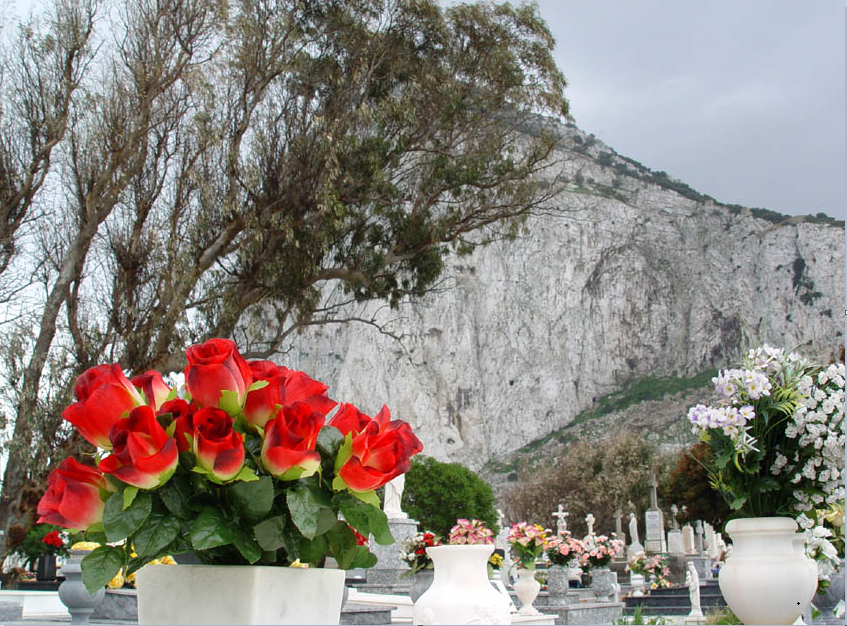
North Front Cemetery, Gibraltar — vibrant floral tributes rest among the graves beneath the towering limestone face of the Rock, a serene place of remembrance framed by nature and history.
The North Front Cemetery is the principal cemetery in Gibraltar and the only one still active for new burials. Established in 1756 on a low-lying isthmus between the historic Devil’s Tower and the former Neutral Ground (the buffer zone by the Spanish border), it was created to address public health concerns over earlier burial practices near the town’s water supply at Red Sands. The site lies at Gibraltar’s north end, with the sheer north face of the Rock to its south and the airfield to its north, giving the cemetery a unique setting. North Front has also been known as the Garrison Cemetery or simply the Gibraltar Cemetery, reflecting its dual role as both a civilian and military burial ground.
Originally, North Front Cemetery was subdivided into five sections for different Christian denominations – including the Church of England, Presbyterian, Wesleyan (Methodist), Catholic, and a fifth area for other Protestant denominations. After the old Jewish burial ground near Windmill Hill (Jews’ Gate Cemetery) closed in 1848, a Jewish section was added to North Front the same year. By the late 19th century, the cemetery continued to expand; for example, a new portion of the Catholic section was consecrated in November 1878 by Bishop Scandella to accommodate Gibraltar’s growing Catholic community. Today the cemetery is broadly organised into four main areas – a Christian section, a Jewish section, a Muslim section and a smaller unconsecrated (general) section – while also accommodating other faiths. The Muslim section was introduced reflecting Gibraltar’s diverse religious community.
Historical Background: The North Front Cemetery’s establishment in 1756 marked a shift in Gibraltar’s burial practices. Before this, burials were often conducted in churchyards or ad hoc sites within the fortified town, which raised sanitation issues. The decision to open a spacious cemetery outside the urban area was driven by “serious concerns over the burial of corpses in the Red Sands” – an area then used for catching rainwater and military drills. Placing the cemetery well clear of the central garrison helped reduce the risk of disease and groundwater contamination. During the tumultuous late 18th century, however, North Front’s location made it vulnerable. The cemetery was essentially on the frontier of the British lines, just south of the Neutral Ground; when the Great Siege of Gibraltar (1779–1783) erupted, this northern area came under enemy fire and became inaccessible. As a result, the British authorities hastily laid out several new burial grounds in Gibraltar’s safer southern district. These included places like Southport Ditch Cemetery (later renamed Trafalgar Cemetery), Witham’s Cemetery (also known as Sandpits), an Engineers’ Road Cemetery, and the new Jewish cemetery near Windmill Hill (Jews’ Gate). This network of southern cemeteries served the community during the siege and subsequent conflicts.
With the end of the Napoleonic Wars, North Front Cemetery resumed its role as Gibraltar’s primary graveyard, and the interim southern cemeteries gradually fell out of use. By 1814, burials at Trafalgar Cemetery and other temporary sites had effectively ceased as peace returned and North Front was once again secure for interments. Thereafter, most Gibraltarians and stationed British personnel were laid to rest at North Front. Over the centuries, countless generations of Gibraltar’s inhabitants – spanning all religions, ranks, and walks of life – have been buried in this cemetery. North Front has thus become an invaluable record of the community’s social history, with graves ranging from the 18th century to the present day. It remains under the care of the Gibraltar authorities; a Superintendent (or Cemetery Manager) oversees operations, supported by a staff of caretakers and gravediggers, to ensure the grounds are maintained and burial protocols followed.
War Graves and Memorials
In addition to serving the local population, North Front Cemetery is of major military significance as Gibraltar’s designated Commonwealth War Graves cemetery. During the First and Second World Wars, Gibraltar was an important naval base and hospital station, and the cemetery was used extensively for the burial of military personnel who died on or near “the Rock.” More than 750 Commonwealth servicemen from the two World Wars are buried or commemorated at North Front, alongside around 40 war casualties of other nationalities. This includes not only members of the British armed forces and Merchant Navy, but also allied troops (for example, sailors and soldiers from places like France, Poland, or Norway who perished in or around Gibraltar) and even a few enemy combatants who died as prisoners or in hospital.
World War I (1914–1918): Gibraltar’s role as a maritime crossroads meant that many WWI casualties came from ships passing through or from the local military hospital. Between 1914 and 1918, 326 burials at North Front were servicemen who died of wounds or illness during the war. These graves are scattered throughout the cemetery’s sections rather than in one distinct plot. Notably, among the World War I dead interred here were 23 sailors of HMS Britannia, who succumbed after the battleship was torpedoed off Cape Trafalgar in November 1918. (The Britannia casualties were brought to Gibraltar in the final days of the war and laid to rest in this cemetery.) Many other WWI graves belong to seamen or soldiers who died of disease in Gibraltar’s hospitals or aboard allied vessels.
After the First World War, the Imperial War Graves Commission (now the CWGC) erected a dignified monument known as the Cross of Sacrifice to honour the fallen. This granite cross, identical in design to those in Commonwealth war cemeteries worldwide, was installed in 1922 on a triangular plot west of North Front Cemetery. It stands at the corner of Winston Churchill Avenue and Devil’s Tower Road, close to the cemetery’s western perimeter. The Cross of Sacrifice in Gibraltar was unveiled on Armistice Day 1922 by the Governor, Sir Horace Smith-Dorrien, in a ceremony reflecting Gibraltar’s gratitude to those who gave their lives. The monument bears the inscription “1914–1918 / 1939–1945: In Glorious Memory of Those Who Died for the Empire,” linking the sacrifices of both world wars.
World War II (1939–1945): Even more extensive use was made of the cemetery during the Second World War. There are approximately 360 WWII burials at North Front Cemetery, the majority being British servicemen from Gibraltar’s own garrison. Some were victims of accidents and enemy air raids during the massive fortress build-up on the Rock. Others were Allied personnel who perished after dramatic escapes to Gibraltar – for instance, soldiers who had been captured in France but managed to flee to the British base, only to die from the ordeals endured. The war grave tally from this period also includes a handful of local defenders. Two members of the Gibraltar Defence Force, Gunners John Azzopardi and Charles Povedano of the 82nd Heavy Anti-Aircraft Regiment, are among those buried here after losing their lives in Gibraltar’s defence. The WWII graves are concentrated in two dedicated plots (one triangular and one rectangular) laid out at the northern end of the cemetery, though some are interspersed among earlier graves due to space constraints.
Following World War II, a second commemorative monument – the Gibraltar Memorial – was added near the Cross of Sacrifice to honour those whose bodies were never recovered. Unveiled after the war, this memorial is a limestone edifice with granite panels listing the names of 98 servicemen who died in or near Gibraltar and were “buried at sea” or otherwise have no known grave. The central inscription on the Gibraltar Memorial expressly links it to North Front Cemetery, noting that these officers and men “were buried at sea with their comrades who lie buried in the North Front Cemetery and in the Jewish Cemetery”, and that “They gave their lives at Gibraltar while serving their country.”
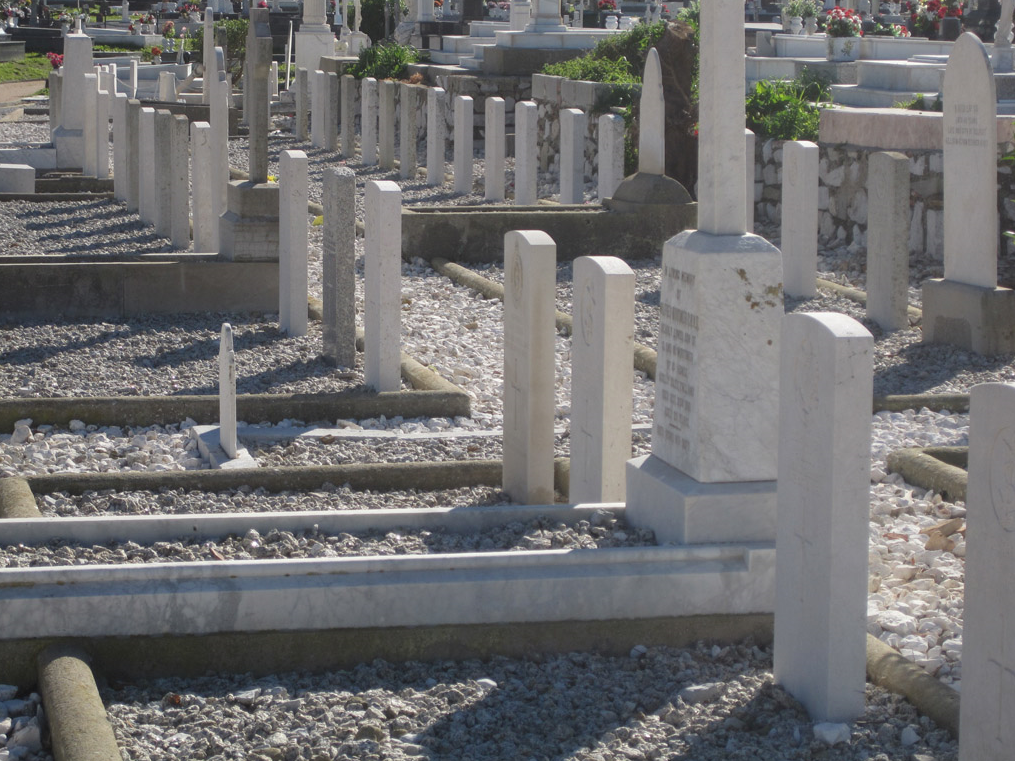
War Graves marking the final resting place of over 750 servicemen from the two World Wars.
Notable Graves and Monuments
Over its long history, North Front Cemetery has become the final resting place for many individuals of note – from governors and war heroes to distinguished civilians – making it a true “Who’s Who” of Gibraltar’s past. Among the most prominent burials are two former Governors of Gibraltar: Lieutenant-General Sir Lothian Nicholson (1827–1893), who died in office and was interred with full military honours, and General Sir Kenneth Anderson (1891–1959), who had served as Governor from 1947 to 1952. Sir Kenneth Anderson is perhaps better known for his earlier role commanding Allied forces in North Africa during WWII, but in Gibraltar he left his mark as a post-war administrator – his grave now recognised for its historical significance. Another towering Gibraltarian figure buried at North Front is Sir Joshua Hassan (1915–1997), Gibraltar’s first Chief Minister and a long-serving civic leader. Sir Joshua, who was of Jewish faith, was laid to rest in the Hebrew section of the cemetery, in a funeral that symbolised the shared heritage of Gibraltar’s Jewish community.
North Front Cemetery uniquely holds the only Victoria Cross recipient buried on Gibraltarian soil. Thomas Henry Kavanagh (1821–1882) was a British civil servant who earned the Victoria Cross – the highest military honour for valour – during the Indian Rebellion of 1857. In his later years Kavanagh served in Gibraltar as a district officer, and upon his death he was interred here. His grave had deteriorated over time but was carefully restored around 2008, ensuring that this hero’s resting place is preserved for posterity. Another serviceman of note is George Campbell Henderson (1910–1951), who was posthumously awarded the George Cross. Henderson was a Royal Navy explosive ordnance expert who died in the tragic Bedenham Explosion of 1951 – a massive ammunition ship blast in Gibraltar’s harbour. He is buried at North Front, and his headstone recounts his gallantry, marking him as Gibraltar’s sole George Cross honouree.
Beyond military figures, the cemetery encompasses the graves of diplomats, scholars, and other notable residents. One fascinating example is Horatio J. Sprague (1784–1848), who served as the United States Consul in Gibraltar for 16 years. Sprague, a beloved local benefactor as well as the longest-serving U.S. consul on the Rock, died in 1848 and was interred at North Front. His grave, now formally protected, is a reminder of Gibraltar’s historic ties with the United States. Another grave of great historical interest is that of Colonel William Willoughby Cole Verner (1852–1922). Col. Verner was a British Army officer, writer, and renowned ornithologist; he is remembered for his explorations in Spain (discovering the prehistoric painted cave of La Pileta) and for inventions such as an improved military compass. Verner spent his later years in Gibraltar and his burial site reflects the esteem in which he was held.
Other distinguished individuals at rest in North Front include high-ranking colonial administrators like Sir Henry Rawlins (d. 1913), as well as Hugh Reilly Semper (d. 1882), another former Chief Justice of Gibraltar. Their presence underscores the cemetery’s role as the preferred burial site for Gibraltar’s elite in the 19th and early 20th centuries. The cemetery also holds the remains of everyday citizens and families who shaped Gibraltar’s community, and even entire family vaults that chronicle multiple generations. In this way, North Front Cemetery is an open-air archive of Gibraltar’s social and civic history.
In addition to individual graves, North Front contains a number of monuments and collective memorials. One notable example is the monument to the 3rd Royal Lancashire Militia, erected in 1855 within the cemetery. This stone memorial commemorates the heavy losses suffered by that regiment and their families during a posting in Gibraltar – including the deaths of two sergeants, 32 privates, six women and twelve children of the unit between July 1855 and June 1856. The monument, inscribed with their names and the regiment’s crest, stands as a poignant reminder of the hardships of 19th-century garrison life (likely due to disease outbreaks during that period). It remains one of the earliest military monuments in the cemetery and has itself become a protected historic artefact.
Today, North Front Cemetery continues to function as an active burial ground, serving all of Gibraltar’s communities. Its ongoing use, however, is carefully balanced with efforts to preserve its historical character. Recognising the heritage value of the cemetery, the Government of Gibraltar and local heritage organisations have taken significant steps to protect and restore important graves and structures. In late 2022, an amendment to Gibraltar’s Heritage and Antiquities Act officially added nine graves and one monument at North Front Cemetery to the roster of protected historical sites. This marked the first time individual tombs in the cemetery received legal protection as monuments. The selection includes the graves of the notable figures mentioned earlier – for example, General Sir Kenneth Anderson, Sir Lothian Nicholson, Thomas Kavanagh VC, Horatio Sprague, and Col. Willoughby Verner are all among those now listed for preservation. Also protected is the aforementioned 3rd Royal Lancashire Regiment monument (1855), given its unique historical significance. By formally designating these graves and memorials, the Government ensures they cannot be removed or altered without special permission, thereby safeguarding them from neglect or redevelopment.
This heritage initiative is part of a broader project to document and conserve North Front Cemetery’s rich patrimony. A comprehensive study of all the graves in the cemetery is ongoing, led by the Department of the Environment in collaboration with the Ministry of Heritage and the Gibraltar National Museum. The aim is to identify further graves of historical interest and eventually to mark them with informational plaques on-site for the benefit of visitors and scholars. The protected graves will be plotted on a detailed map of the cemetery, creating an interpretive trail that highlights Gibraltar’s history through the individuals buried there. As the Minister for Heritage, Prof. John Cortes, noted in 2022, “North Front Cemetery is the resting place of many former residents of Gibraltar. Some of the graves and monuments have great historical interest and value… We have started the process of identifying [and protecting] some of these, particularly the older ones and those of persons who no longer have descendants in our community to look after their graves.” This statement reflects the community’s commitment to honouring its forebears and preventing the erasure of their memory.
Looking ahead, the dual role of North Front Cemetery – as a working cemetery and an open-air historical museum – will continue to be managed with care. Public access is facilitated during daytime hours for those wishing to visit family graves or explore the historic sections. The Cemetery Board (established under the Cemeteries Act) advises on the cemetery’s operations, maintenance standards, and heritage conservation efforts. Through these measures, Gibraltar is ensuring that North Front Cemetery remains a dignified place of rest for current and future generations, while also preserving the stories etched in its weathered tombstones. In sum, Gibraltar’s North Front Cemetery stands as a chronicle in stone – a place where the territory’s multicultural heritage, military history, and community life all converge, safeguarded for posterity.
Sources:
- Chipulina, Neville. About Our Rock – North Front Cemetery. (Archived)
web.archive.orgweb.archive.orgweb.archive.org - Commonwealth War Graves Commission (CWGC). Gibraltar (North Front) Cemetery
en.wikipedia.orgen.wikipedia.org - Gibraltar National Museum News. “Graves of historical interest protected.” (29 Nov 2022)
gibmuseum.gigibmuseum.gi - Ministry for Heritage (Gibraltar). Trafalgar Cemetery (Heritage & Antiquities Listing)
ministryforheritage.giministryforheritage.gi (for historical context) - Wikipedia. “North Front Cemetery – Gibraltar.” (Accessed 2025)
en.wikipedia.orgen.wikipedia.org
Other former burial grounds
While no longer open for new burials, several cemeteries across Gibraltar are protected and preserved given their historical and cultural significance.
Jews’ Gate Cemetery
First opened in 1746, this Jewish cemetery served the community until 1848, when burials were moved to North Front. Jew’s Gate Cemetery was restored and reopened in May 2015. Today it stands as a memorial site within the Gibraltar Nature Reserve: Upper Rock.
Trafalgar Cemetery
Consecrated in 1798 and in use until around 1814, Trafalgar Cemetery is more well known as the final resting site for the victims of past epidemics in Gibraltar and nearby maritime accidents including servicemen wounded in the naval Battle of Trafalgar. The site was restored in the 1980s and now serves as a historic site with annual commemorative ceremonies.
St. Jago’s Cemetery
Also known historically as Deadman’s Cemetery, it originally served impoverished Gibraltarian residents before burials were redirected to Trafalgar Cemetery and subsequently to North Front. Closed in the early 20th century, the site became part of St. Jago’s Barracks. Many of the original headstones were relocated to Trafalgar Cemetery in 1932 to preserve their historical value.
Witham’s Cemetery
Located near South Barracks, Witham’s Cemetery was primarily used during the 18th and early 19th centuries for British military burials. Though no longer in use, it remains a site of historical importance, commemorating Gibraltar’s military heritage. The site is presently managed by volunteers the Gibraltar Heritage Trust. Additional information on Witham’s Cemetery is available from the following websites:
https://www.ministryforheritage.gi/heritage-and-antiquities/withams-sandpits-cemetery-1060
https://gibraltarheritagetrust.org.gi/knowledge/upcoming-projects